import matplotlib.patches as mpatches
import matplotlib.pyplot as plt

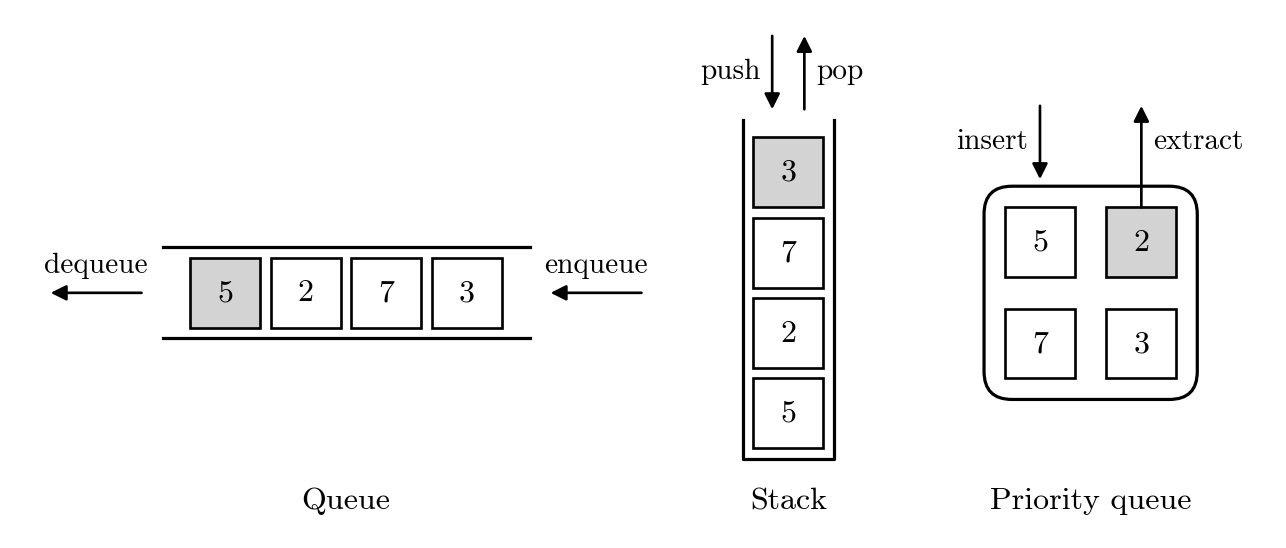
added = [5, 2, 7, 3]  # the numbers, in the order they are added
gap = 0.15  # gap between boxes, and between boxes and walls
length = len(added) + (len(added) - 1) * gap  # length of a line of boxes
middle = length / 2  # the queue and the priority queue are centered on the stack
arrow = dict(arrowstyle="-|>", color="black", mutation_scale=12, shrinkA=0, shrinkB=0)
wall = dict(color="black", linewidth=1.2)
label_style = dict(va="center", fontsize=11)
title_style = dict(ha="center", va="center", fontsize=12)


def draw_box(ax, x, y, number, gray):
    """Draw a unit box with the number and its lower-left corner at (x, y)."""
    ax.add_patch(
        mpatches.Rectangle(
            (x, y),
            1,
            1,
            facecolor="lightgray" if gray else "white",
            edgecolor="black",
            linewidth=1,
        )
    )
    ax.text(x + 0.5, y + 0.5, str(number), ha="center", va="center", fontsize=12)


def draw_arrow(ax, tail, head):
    """Draw an arrow from tail to head."""
    ax.annotate("", xy=head, xytext=tail, arrowprops=arrow)


# Computer Modern fonts, as in LaTeX. The last setting avoids a warning about cmr10.
latex_style = {
    "font.family": "cmr10",
    "mathtext.fontset": "cm",
    "axes.formatter.use_mathtext": True,
}
with plt.rc_context(latex_style):
    fig, ax = plt.subplots(figsize=(6.5, 2.7))

    # Queue: a number enters at the right end and leaves at the left end
    x0, y0 = 1.7, middle - 0.5
    for j, number in enumerate(added):
        draw_box(ax, x0 + j * (1 + gap), y0, number, gray=(j == 0))
    left, right = x0 - gap - 0.25, x0 + length + gap + 0.25  # ends of the walls
    for y in (y0 - gap, y0 + 1 + gap):
        ax.plot([left, right], [y, y], **wall)
    draw_arrow(ax, (left - 0.3, middle), (left - 1.6, middle))
    ax.text(left - 0.95, middle + 0.4, "dequeue", ha="center", **label_style)
    draw_arrow(ax, (right + 1.6, middle), (right + 0.3, middle))
    ax.text(right + 0.95, middle + 0.4, "enqueue", ha="center", **label_style)
    ax.text(x0 + length / 2, -0.75, "Queue", **title_style)

    # Stack: a number enters and leaves at the top
    x0 = right + 3.2
    for j, number in enumerate(added):
        draw_box(ax, x0, j * (1 + gap), number, gray=(j == len(added) - 1))
    left, right, top = x0 - gap, x0 + 1 + gap, length + 0.25  # walls
    ax.plot([left, left, right, right], [top, -gap, -gap, top], **wall)
    draw_arrow(ax, (x0 + 0.27, top + 1.2), (x0 + 0.27, top + 0.15))
    ax.text(x0 + 0.1, top + 0.7, "push", ha="right", **label_style)
    draw_arrow(ax, (x0 + 0.73, top + 0.15), (x0 + 0.73, top + 1.2))
    ax.text(x0 + 0.9, top + 0.7, "pop", ha="left", **label_style)
    ax.text(x0 + 0.5, -0.75, "Stack", **title_style)

    # Priority queue: the numbers are in no particular order, and the smallest leaves
    step = 1 + 3 * gap  # distance between neighboring boxes
    size = 1 + step  # width and height of the 2 x 2 grid of boxes
    x0, y0 = x0 + 3.6, middle - size / 2
    for j, number in enumerate(added):
        row, col = divmod(j, 2)  # filled row by row from the top left
        x, y = x0 + col * step, y0 + (1 - row) * step
        draw_box(ax, x, y, number, gray=(number == min(added)))
    pad = 0.3  # gap between the grid and the wall
    ax.add_patch(
        mpatches.FancyBboxPatch(
            (x0 - pad, y0 - pad),
            size + 2 * pad,
            size + 2 * pad,
            boxstyle="round,pad=0,rounding_size=0.4",
            facecolor="none",
            edgecolor="black",
            linewidth=1.2,
        )
    )
    top = y0 + size + pad  # top of the wall
    draw_arrow(ax, (x0 + 0.5, top + 1.15), (x0 + 0.5, top + 0.1))
    ax.text(x0 + 0.33, top + 0.65, "insert", ha="right", **label_style)
    x = x0 + step + 0.5  # above the smallest number, 2, at the top right
    draw_arrow(ax, (x, y0 + size), (x, top + 1.15))
    ax.text(x + 0.17, top + 0.65, "extract", ha="left", **label_style)
    ax.text(x0 + size / 2, -0.75, "Priority queue", **title_style)

    ax.set(xlim=(-0.75, x0 + size + 1.3), ylim=(-1.15, length + 1.7), aspect="equal")
    ax.axis("off")
    fig.subplots_adjust(left=0, right=1, top=1, bottom=0)
    plt.show()