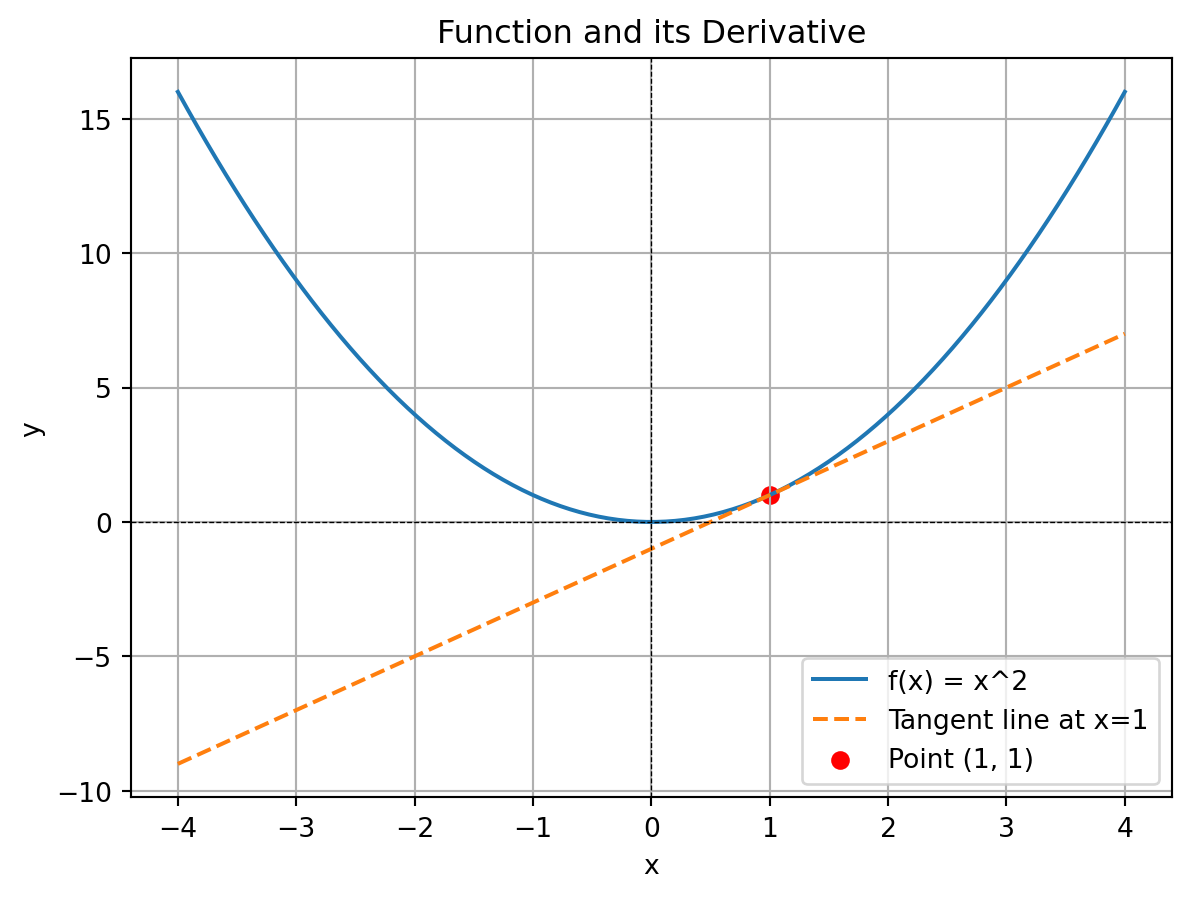
関数 y = f(x) を最小化する問題を考える.ここで,x ,y は実数であるとする.f(x) の導関数は f'(x) や \frac{df}{dx} と書く.導関数 f'(x) は,点 x における関数 f(x) の傾きを表す.
例 18.1 (導関数の例) f(x) = x^2 の導関数は f'(x) = 2x である.例えば,点 x = 1 における導関数の値は f'(1) = 2 であり,これは点 (1, 1) における関数 f(x) の傾きが 2 であることを意味する.下記の図は,関数 f(x) = x^2 と点 (1, 1) における接線を示している.
コード
import numpy as npimport matplotlib.pyplot as pltdef f(x):return x** 2 def df(x):return 2 * x# 点 (1, 1) における接線 def tangent_line(x):return 2 * (x - 1 ) + 1 = np.linspace(- 4 , 4 , 100 )= "f(x) = x^2" )= "Tangent line at x=1" , ls= "--" )1 , f(1 ), color= "red" , label= "Point (1, 1)" )"Function and its Derivative" )"x" )"y" )0 , color= "black" , lw= 0.5 , ls= "--" )0 , color= "black" , lw= 0.5 , ls= "--" )
アルゴリズム
\mathbf{x} \in \mathbb{R}^n の関数 f(\mathbf{x}) を最小化する問題を考える.ここで,f は微分可能であるとする.
勾配降下法は,以下の式で与えられる更新式を繰り返すことで,f の極小値を求めるアルゴリズムである.
\mathbf{x}^{(k+1)} = \mathbf{x}^{(k)} - \alpha \nabla f(\mathbf{x}^{(k)})
ここで,\nabla f(\mathbf{x}) は f の勾配を表し,\alpha はステップサイズを表す.
勾配 \nabla f(\mathbf{x}) は,以下のように定義される.
\nabla f(\mathbf{x}) = \left[ \frac{\partial f}{\partial x_1}, \frac{\partial f}{\partial x_2}, \ldots, \frac{\partial f}{\partial x_n} \right]
\alpha は,ステップサイズを表すハイパーパラメータであり,適切な値を選択することでアルゴリズムの収束性能を向上させることができる.
勾配降下法は,勾配の逆方向に進むことで,関数 f の極小値を探索するアルゴリズムである.
勾配降下法の停止条件として,よく使われるのは以下の式である.
\|\nabla f(\mathbf{x})\| < \text{tol}
\|\cdot\| はベクトルのノルムを表し,\text{tol} はあらかじめ与えられた許容誤差である.
Algorithm 18.1 (勾配降下法)
Input : 関数 f ,勾配 \nabla f ,初期点 \mathbf{x}^{(0)} ,ステップサイズ \alpha ,許容誤差 \text{tol} Output : 最小値を与える \mathbf{x} の推定値
\mathbf{x} \leftarrow \mathbf{x}^{(0)} while \|\nabla f(\mathbf{x})\| > \text{tol} do
\mathbf{x} \leftarrow \mathbf{x} - \alpha \nabla f(\mathbf{x}) return \mathbf{x}
Python による実装
import numpy as npdef gradient_descent(f, grad, x0, alpha= 1e-3 , tol= 1e-6 ):""" Gradient descent (optimization algorithm) Parameters ---------- f : function The function to minimize grad : function The gradient of the function x0 : np.ndarray Initial guess alpha : float Step size tol : float Tolerance Returns ------- x : np.ndarray The estimate of the minimum """ = x0while np.linalg.norm(grad(x)) > tol:= x - alpha * grad(x)return xdef f(x):return x[0 ]** 2 + x[1 ]** 2 def grad(x):return np.array([2 * x[0 ], 2 * x[1 ]])= np.array([1.0 , 1.0 ])= gradient_descent(f, grad, x0)print (x)
[3.52977395e-07 3.52977395e-07]